Curllective
Curl + Collective
A digital platform designed to help people with textured hair (curls, coils, and waves) find the right products more affordably, reduce product, financial, and environmental waste, and connect with a community for advice, shared experiences, and support.
August 2025 - December 2025
Empathize
Ideate
Design
Prototype
Test
Quick Overview
The Problem
People with textured hair often struggle to find products that truly work for their unique hair type, leading to frustration, wasted money, and trial-and-error routines. With thousands of products on the market and limited transparency around ingredients, results depend on expensive experimentation, often based on recommendations made by social media influencers.
How might we… help people with textured hair discover products that work for them while reducing trial-and-error, cost, and product waste?
The Solution
I designed Curllective, a digital platform that combines personalized product recommendations, ingredient transparency, and community-driven features to help people with textured hair make more informed haircare decisions. The platform helps users save money, minimize waste, and discover products tailored unique hair needs. It also serves as a dedicated space for shared experiences, education, and connection, empowering users to navigate their haircare journey with greater confidence.
Jump to design
Product Goals
Simplify personalized product discovery by helping users identify products, ingredients, and routines that align with their specific hair type and needs.
Reduce financial, product, and environmental waste by minimizing costly trial-and-error purchasing and encouraging more sustainable product choices.
Facilitate a supportive, digital community where users can share experiences, advice, and trusted recommendations tailored to curls, coils, and waves.
Empathize
Utilized Methods
Interviews & Affinity Diagram
Persona
Journey Mapping
User Discovery
I conducted four interviews to ensure this is truly a problem that needs to be addressed and understand all potential pain-points people may experience. My screener questions were designed to ensure participants aligned with my target audience: people who have textured hair (Type 2A- 4C) and who started a haircare journey with the last two years.
Data Synthesis
Key Takeaways
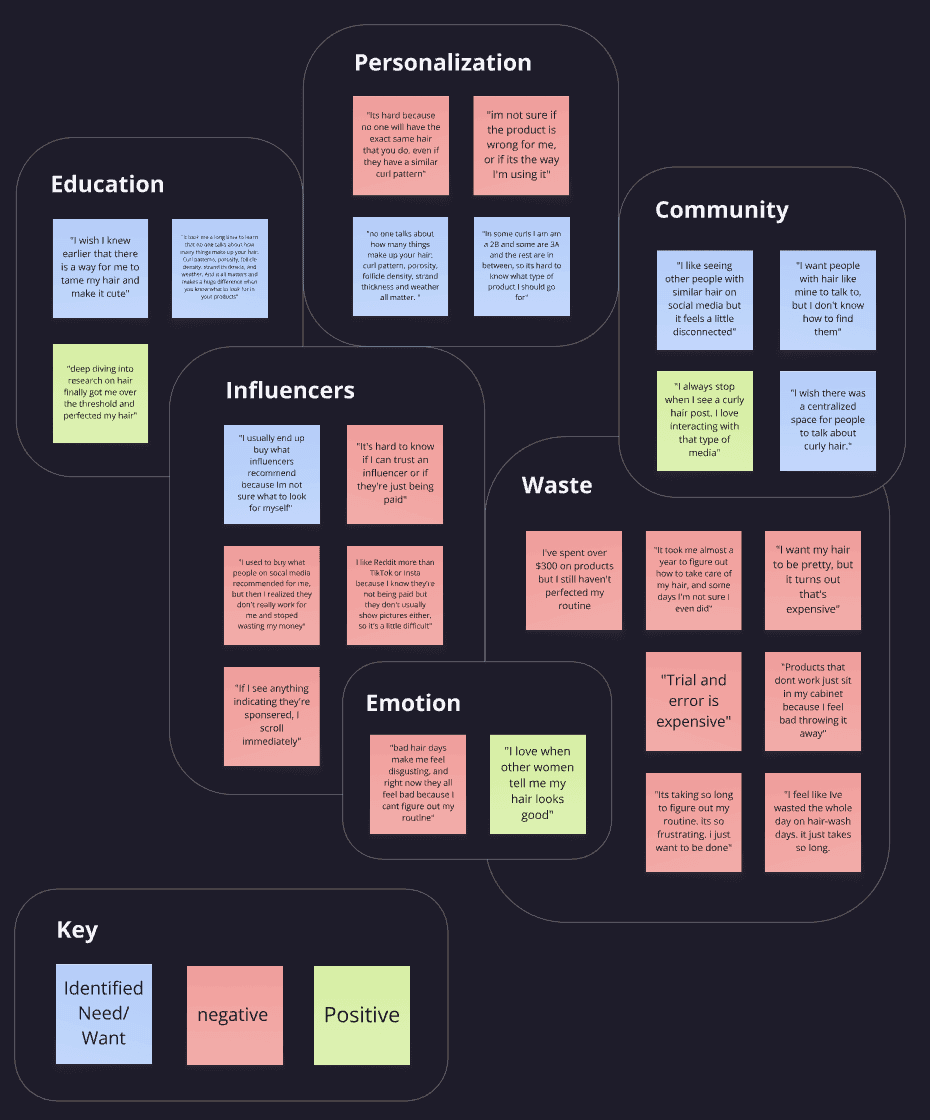
Many avoided their natural curls at first due to lack of knowledge, being overwhelmed by options, or continuous failure.
Product, money, and time are often wasted while people are going through the Trial and error phase, where everyone starts off.
Many rely on social media like TikTok and Reddit but struggle with influencer bias and lack of personalized advice.
Affinity Diagram
User Personas
Maya has always struggled to find the right routine for her 2C/3A curls and has now decided to revamp her routine. However she is struggling with finding the right products without causing waste, and as a Sustainability major, thats just unacceptable. She needs a way to figure out her routine without contributing to the antithesis of her studies and values.
Abbi is finally learning how to care for her 3C curls after years of relaxing her hair. But the process feels overwhelming. Between endless product recommendations, social media pressure, and not always knowing where to start, she struggles to know what she needs to do. She wants to reach out for support, but has social anxiety and doesn't like the thought of the whole world having access to her comments on major social media platforms. She wants a safe, supportive space where she can ask questions and get real advice.


Journey Mapping

Through user interviews and research, I found that people with textured hair often face costly trial-and-error routines, overwhelming product choices, and limited access to trustworthy, personalized guidance. Many users also expressed a strong desire for centralized community support, unbiased recommendations, and sustainable solutions that reduce both financial and environmental waste. Overall, the research revealed that textured hair care is not just a product issue. It has a broader need for education, connection, and accessibility.
Ideate
Utilized Methods
Site Mapping
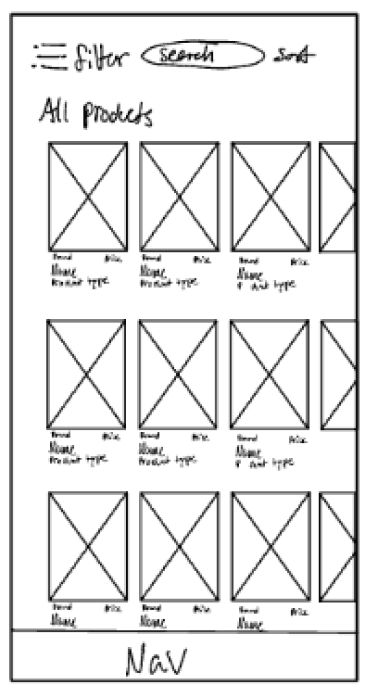
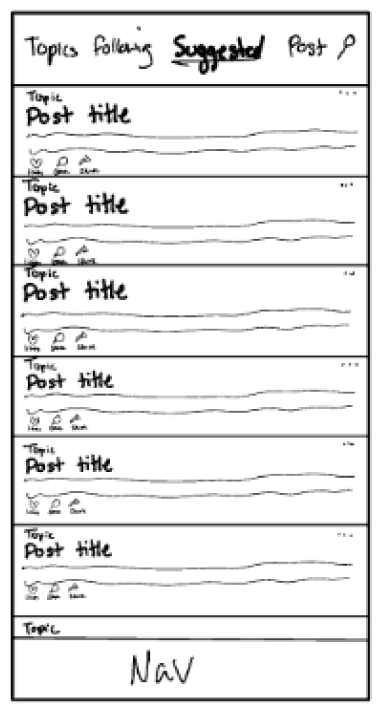
Sketches
Design Decisions
Personalization
Understand the users unique hair type, texture, and needs to be best able to recommend products that will work for them from a scientific approach.
Community
Create a space where every user can interact with others if they would like. Drawing inspiration from Reddit, Instagram, and TikTok, posts can be in any format to ensure all users can feel comfortable with the exposure.
Sustainability
Connect with brands and acquire travel/ trial sized product to sell directly on the app. Also incorporate a monitored send- back program so users don't have to agonize over unused product and bottles.
Site Map




Design
Utilized Methods
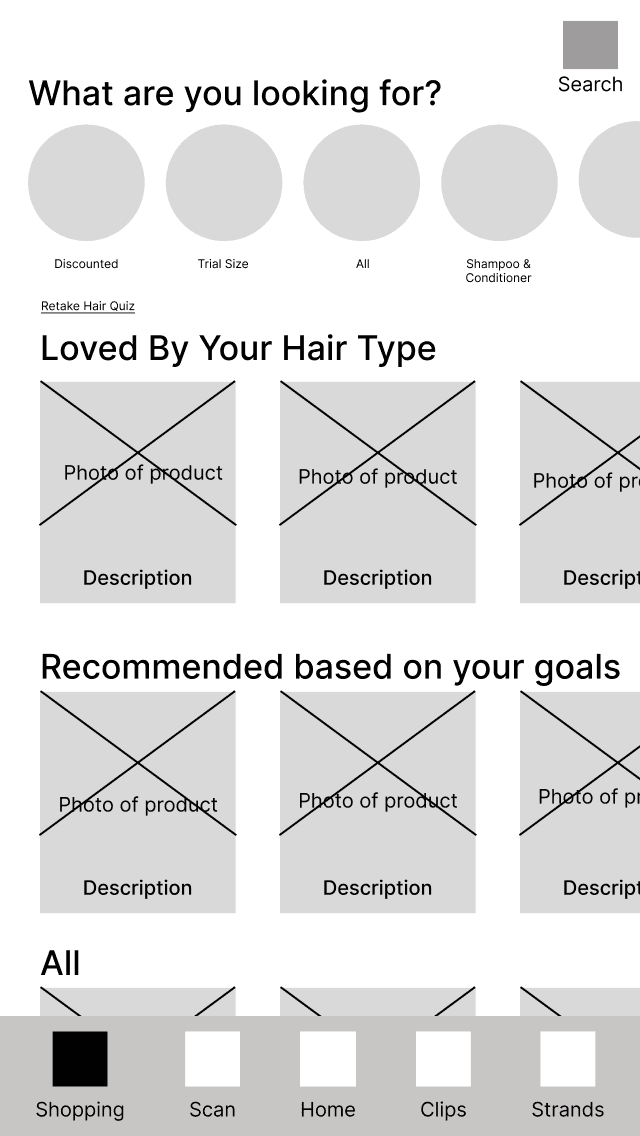
Low Fidelity Designs
Mid Fidelity Designs
High Fidelity Designs
Design System

Lo-fi. Mid-fi. Hi-fi.



Prototype
In Retrospect…
Due to the course timeline and assignment constraints, I was not able to follow through with a proper usability test and was only able to make corrections of the design based on comments from friends and peers. Had I had the chance I would have conducted usability tests and implemented feedback.
Furthermore, I would have built out more of the prototype, including creating the hair quiz for onboarding and making the home page cards more interactive; clicking would reveal information on each aspect of the user's unique hair to allow them greater access to information.
I would have also liked to further explore the feasibility and mechanics of the "Trade- In" feature. While I think it would be a beneficial and sustainable option for users, it remains uncertain how to ensure the safety of the service, reduce liability, and protect the company as a whole.